
Tualatin factories, retail roofs, and backyards get crane lifts and steel buildings from one licensed crew, rigging included.
Crane and steel work in Tualatin splits with the city itself. The south end, where the manufacturing and distribution buildings sit, generates equipment placement, machinery moves and rooftop unit swaps that have to be planned around a production floor still running. The north edge is retail and office property, where mechanical units get flown from a parking lot. In the Basalt Creek employment area it turns into shells: flex and manufacturing-park steel, erected rather than picked. Every lift is operated: the operator carries NCCCO certification, the gear is chosen for that specific load, and what a facilities engineer buys is a completed lift rather than a machine plus a search for a rigger. Tonnage classes run from 55 up to 350.
Two questions decide the paperwork before a date gets set. If an outrigger or a wheel ends up in a Tualatin street or sidewalk, the Engineering Division is the desk that permits it, and the City's own franchise language counts parking a rig inside the right-of-way to work nearby as covered activity. That application expects a traffic control plan, contractor insurance whose policies name the City, its officers and employees as additional insured parties, and financial assurance under the Public Works Construction Code. If the parcel sits in the mapped floodway or the 100-year floodplain of the Tualatin River, a Flood Hazard Area Development Permit rides with the building permit. Send a weight, a working radius, and the street address.
Tualatin calls range from rigging inside a running plant to a spa lowered over a backyard fence, with four services covering the span.

Frames stood up on the employment-district parcels at the south end of town, where one company runs the erection and the machine that lifts each piece, on one schedule.

Rooftop units swapped on retail, office and light industrial roofs, with the setup planned around the parking a property can hand over for a morning.
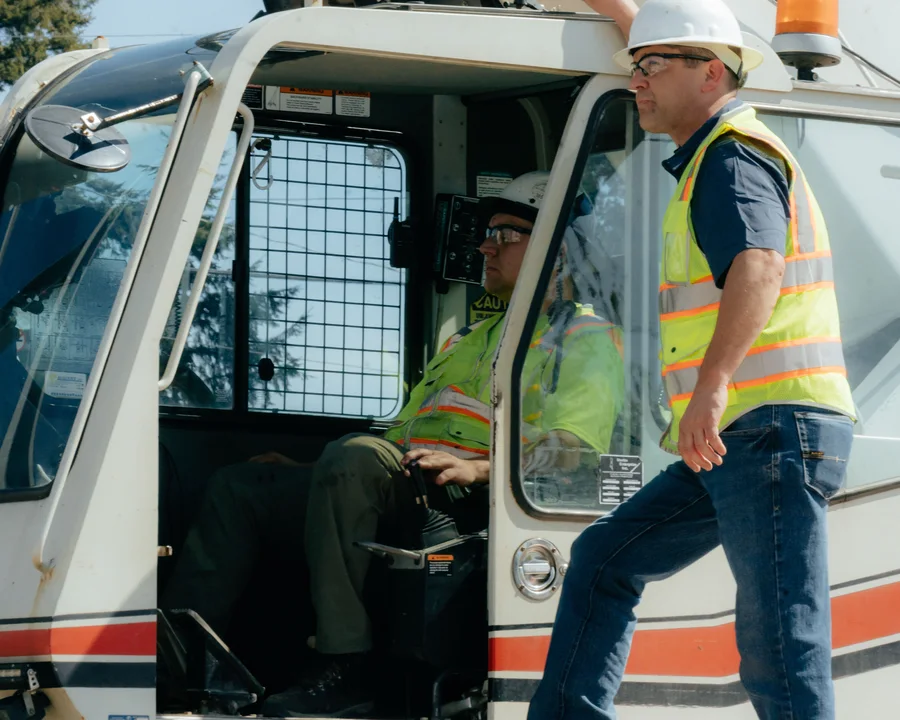
Machinery, vaults, transformers and process tanks rigged, flown and set down once, inside a live facility where the production schedule owns the window.
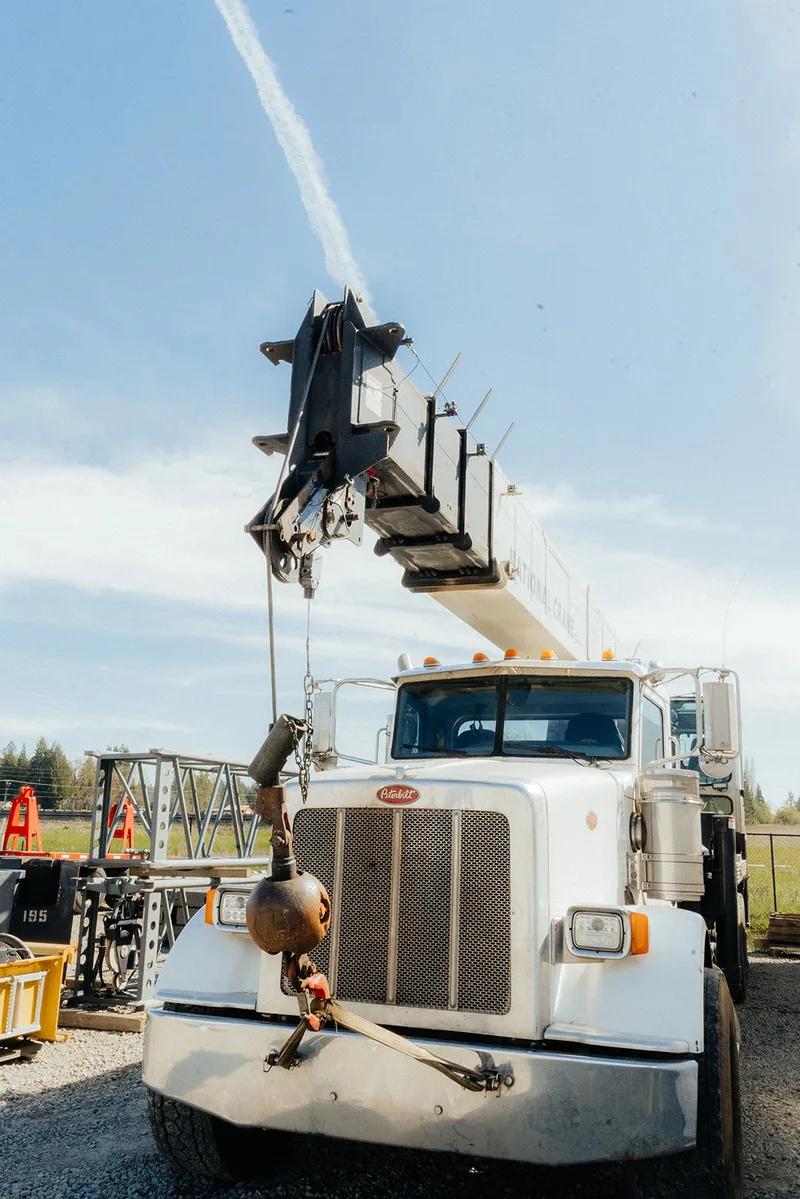
A hot tub or spa taken up over the roof and eased down onto its pad, so fence panels, gates and plantings stay untouched.

A crane that sets outriggers in a Tualatin street is doing permitted work, not borrowing space for an afternoon. The City's franchise permit language lists parking vehicles in the right-of-way to perform work nearby among the activities that require a permit, and the Engineering Division is the desk that reviews and approves it. Anyone who assumed a two-hour pick needed nothing is better off hearing that early.
The packet has three parts. A traffic control plan, which the City defines as a site plan of how traffic flows past the work while it happens. Proof of contractor insurance whose policies add the City, its officers, employees and agents as insured parties. And financial assurance guaranteeing whatever gets built inside the City right-of-way. The City requires all three; Westmore produces the drawing and submits the application.
Ground decides as much as paper. A parking lot built on fill behaves differently under outrigger pads than a plant apron poured for loaded trucks, so matting goes down when the bearing is uncertain. Pictures beat measurements here: where the machine would sit, the arc the load must follow, and anything strung overhead.

Low ground along the Tualatin River gets settled before anything else on a steel building here. A parcel inside the mapped floodway or the 100-year floodplain picks up a Flood Hazard Area Development Permit beside the commercial building permit, and that permit shapes the foundation and how high the finished floor has to sit before any steel gets ordered. The City publishes a floodplain page where an address is checked against the mapped areas.
Tualatin issues its own commercial building permits through the City's Building Division instead of routing them to Washington County, and that one desk covers new construction, additions, remodels and the plumbing, mechanical and site utility permits attached to them. Westmore runs that process as commercial general contractor, putting plan review, inspections and the erection crew behind one phone number.
Employment ground on the south edge, Basalt Creek among it, is written around flex and manufacturing-park buildings, which means clear-span steel erection rather than a single pick. Columns, beams and joists go up on the sequence the erection drawings set, and the same crew can carry the shell through roof and wall sheeting into the exterior finishing that closes it in.
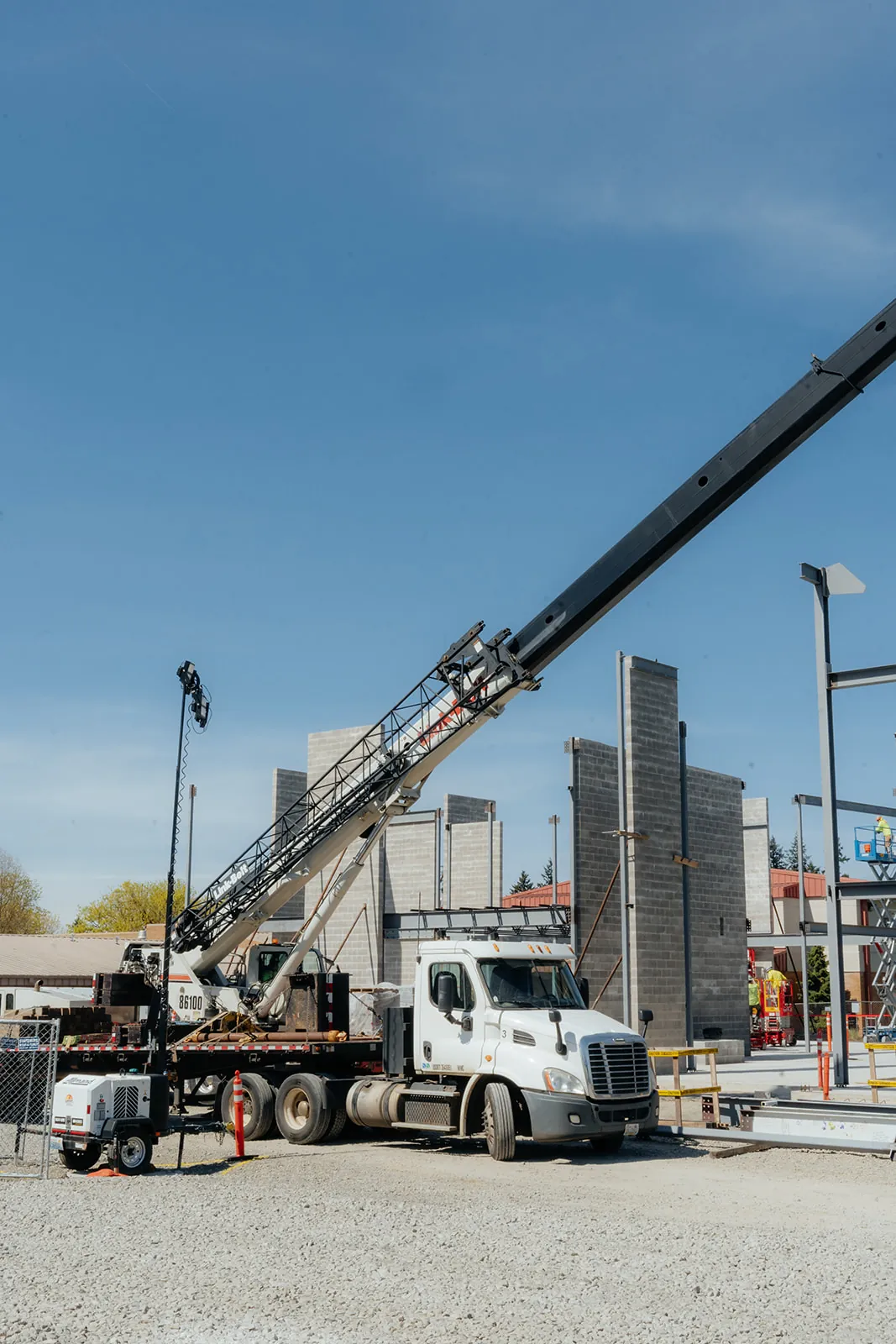
A truck crane set beside tilt-up panels, trailer staged behind it.
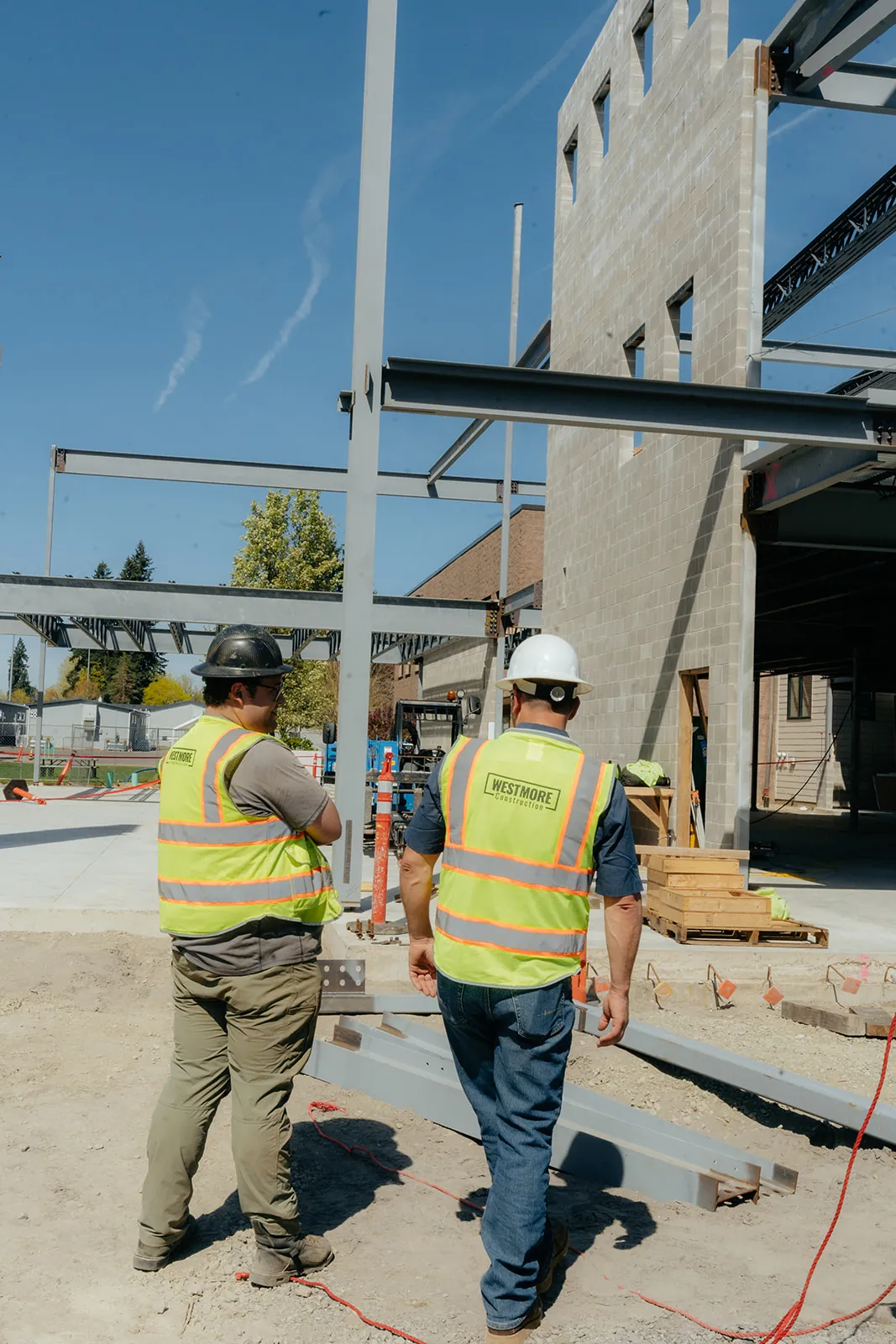
Crew inside a steel column and beam frame during erection.

A street set, cones out and traffic control in place.
Call with the load weight, the address, and the date you have in mind, or send the basics below and we call back within 24 hours.
"Great people to work with. We have worked with both sides, the construction team and the crane services and have been absolutely amazed with the professionalism and their communication skills. We get to hire their crane fairly often for picking larger concrete vaults and they are always quick to respond with timing and pricing for each project. We wouldn't want to use anyone else!"
Google review
"Fast to work with me when I had a short notice crane pick request for downtown Portland. Yikes. No problem for these guys. They nailed the permit, traffic, and planning submittals in no time... They were safe, they worked fast... From the big boy 350 Ton to little boy crane needs - they are our team now."
Google review
"Westmore Construction is a very honest and trustworthy crew. That is why we selected them as our general contractor and our pre-engineered metal building installer for our commercial project. They worked well with all the permitting staff, inspectors, and subcontractors. They worked hard to keep our project moving through the entire process and they cared about our timeline for completion. Plus, their entire team communicated well and timely. What more could you really ask for in a GC? I would highly recommend Westmore Construction and I would hire them again if we have a chance to develop another property in the future."
Google review
Yes, from the manufacturing and distribution district on the south end to the retail and office blocks on the north edge. Two things set the date. First, which machine size the job calls for once the weight and the working radius are known. Second, whether the setup needs street space, because that application clears on the City of Tualatin calendar.
Yes, whenever the setup occupies a street or a sidewalk. The Tualatin Engineering Division handles the permit covering work that fronts residential or commercial property inside the right-of-way. The City also counts parking a rig there to perform nearby work as covered activity. Outriggers holding a travel lane are exactly that. Westmore prepares and files the application rather than handing it back.
Three things: what the load weighs, how far the boom must swing to place it, and the street address. Photographs along that path add what measurements miss: overhead lines, gate widths, fence height, and the surface the outrigger pads will bear on. Mention it if the machine will stand on public pavement, because right-of-way approval runs on its own track.
The machine follows the setup, not the unit. A boom loses capacity the more it has to extend, so where the outriggers can plant themselves settles the class before the equipment weight does. A unit landed off a wide plant apron can take a smaller machine than the same unit lifted from behind a tight retail frontage, where the boom reaches farther to get there.
Yes, and the floodplain question gets settled before steel is ordered. Parcels inside the mapped floodway or the 100-year floodplain of the Tualatin River need a Flood Hazard Area Development Permit next to the commercial building permit, which changes foundation work and how high the finished floor has to sit. The City publishes a floodplain page for checking an address. Start with the plan set.
The City of Tualatin Building Division, not Washington County. It handles every step for new commercial construction, remodels and additions, along with the plumbing, mechanical, sign and site utility permits that ride with them. That means one plan review desk for the shell and the trades. Westmore carries that process as the commercial general contractor, with the erection crew working to the same schedule.
Tigard, Sherwood, Durham, and King City addresses draw the crew and machines that work inside Tualatin.
Send the load weight, the working radius, and the Tualatin address, or the plan set if the job is a building. Note whether the machine will need to stand on public pavement.
Battle Ground, WA
Fields marked * are required.
We call back within 24 hours. Prefer to talk? (360) 772-1040