
Crane work and steel building construction in Astoria, Oregon, sized to the ground each job stands on, operator and rigging included.
In Astoria, Westmore handles operated crane work and builds steel structures. Lifting here covers rooftop mechanical on downtown and Uniontown commercial property, equipment and material picks around the working waterfront, structural steel out on the flat industrial ground at Warrenton, and spas dropped into gardens up on the hill. Each machine arrives with its operator, NCCCO certified, and with rigging matched to the load, so an owner or a mechanical contractor hires a finished lift rather than three bookings. The fleet holds three classes, topped by a Grove all terrain rated at 350 tons, and what is being picked decides which one comes.
Astoria Public Works Engineering issues one approval covering excavation, traffic control, or other substantial impacts within a public street, plus a separate temporary street use application for closing a lane, a parking space, or a sidewalk, which is exactly what a crane in the street is doing. Only contractors licensed in Oregon may perform that work. What sits under the pavement is the other question, because the commercial district was built on wood piles over a filled tideland, and bearing has to be proven, never presumed. Send us the tonnage, the reach, and the address.
Four kinds of pick fill it: rooftop units downtown, rigging along the working waterfront, structural steel out at Warrenton, and spas on the hill.

Columns and joists landed on the flat serviced ground at Warrenton, put up by the crew that brought the crane.

Rooftop units placed on downtown commercial buildings, worked from a street the permit has to cover first.
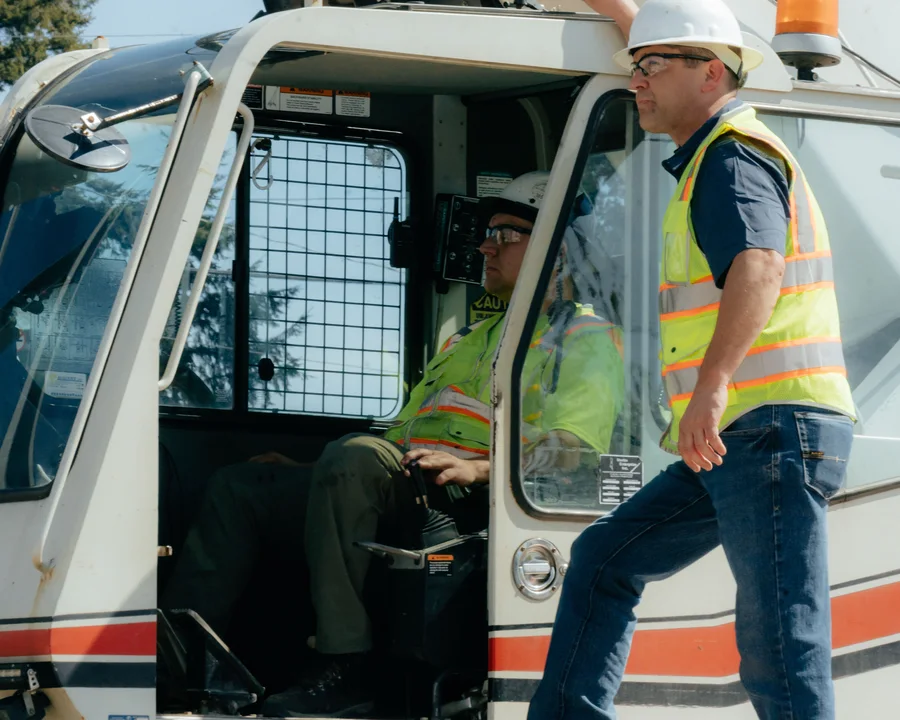
Vessel gear, tanks, and mechanical equipment slung and landed along a working waterfront, inside the window a berth leaves open.

A spa flown clear of a fence and a hillside garden, then lowered onto its pad with nothing taken apart.

The commercial district was built on wood piles driven into filled tideland, so what sits under a downtown setup is a deck rather than native soil. Allowable bearing, mat size, and cribbing have to be worked out against that before the outriggers come down. Send the address early; bearing gets calculated for that specific site.
The hillside changes the arithmetic again. Lidar mapping puts better than half of the city in the high susceptibility band for shallow landsliding, so choosing a position on a slope is a stability decision as much as a reach decision. Narrow streets on grade argue for a larger machine standing back rather than a smaller one squeezed in close.
Work along the waterfront runs on somebody else's clock, since berths, vessel movements, and terminal operations set the window a pick can happen inside. The pick gets planned around that window instead of the other way round. Tell the estimator what the piece weighs, where it lands, and who controls access to the site.

A steel building here is a foundation conversation before it is a frame conversation. Lidar mapping puts better than half the city in the high susceptibility band for shallow landsliding, so a hillside parcel carries foundation and drainage engineering a flat valley site never asks for, and downtown the pile supported tideland decides what a slab can bear. Those answers come out of the geotechnical work.
Flat, serviced, developable industrial ground in this market sits out at the airport in Warrenton, a separate incorporated city with its own approvals, and that is realistically where a new building goes. It is also ground where a raised boom can fall inside the federal notification surfaces around a field, so the street address belongs in the first conversation rather than the last one.
Exposure then sets two lines of the specification at once: Clatsop County sits inside an Oregon special wind region and open coast frontage falls in the harshest marine corrosivity band, which sizes the frame and sets the coating stack for this coast rather than for the valley. Westmore holds the commercial general contractor role here and puts the frame up with cranes it owns.

Outriggers and counterweight set, the part that decides what a crane can pick.

Steel frame and panels going up on a commercial shell.

The hook block working over a wall, load headed for its landing.
One call covers crane size, the permit, and the schedule. Or send the basics below and we call back within 24 hours.
"Great people to work with. We have worked with both sides, the construction team and the crane services and have been absolutely amazed with the professionalism and their communication skills. We get to hire their crane fairly often for picking larger concrete vaults and they are always quick to respond with timing and pricing for each project. We wouldn't want to use anyone else!"
Google review
"Fast to work with me when I had a short notice crane pick request for downtown Portland. Yikes. No problem for these guys. They nailed the permit, traffic, and planning submittals in no time... They were safe, they worked fast... From the big boy 350 Ton to little boy crane needs - they are our team now."
Google review
"Professional, responsive, and easy to work with. Highly recommend Westmore crane services."
Google review
Yes, Astoria itself plus Warrenton and the steep streets above Uniontown. Oregon registration CCB 234945 backs the lifting and the building work. The date turns on which machine the load takes and on whether the setup claims a public street, which the city approves separately. Send a photo of the intended setup area.
Yes, as soon as the machine occupies the street. Astoria Public Works Engineering handles the approval for work involving excavation, traffic control, or other substantial impacts, and a temporary street use application for closing a lane, a parking space, or a sidewalk. A temporary traffic control plan accompanies that application. Westmore completes and submits both.
By engineering the setup rather than assuming it. The commercial district was built on wood piles over filled tideland, so allowable bearing, mat size, and cribbing get calculated for the specific address before a truck rolls. Up on the hill, slope stability governs where a machine can stand at all, which points to picking at a longer radius with a bigger crane.
Wind and salt, in that order. Clatsop County lies inside an Oregon special wind region, so frames, anchor bolts, and fastener schedules are sized for coastal design speeds a valley package never sees. Anything within roughly a kilometer of open coast also sits in the harshest atmospheric corrosivity band, where the specified system is a zinc rich primer under epoxy and polyurethane coats. Both belong in the number from day one.
Yes, and the slope sizes the machine. What decides it is the flight path rather than the tub: how tall the fence stands, what tree limbs sit along the line, the roofline that has to be cleared, and whether a truck can legally sit on a street with that grade. A single photo along that line settles the class faster than a page of measurements.
Yes. Westmore Construction appears on the Oregon Construction Contractors Board register under CCB 234945, and a million dollar liability policy covers work in Oregon and Washington. Operators are NCCCO certified. Astoria allows only Oregon CCB licensed contractors to perform right of way work, which matters on any downtown setup that claims a lane.
Warrenton is a separate incorporated city with its own approvals, and it books the same cranes, operators, and rigging as the Uniontown streets or the downtown core.
Tell us the tonnage, the reach, and the Astoria address, and say whether the setup lands downtown, up on the hill, or out at Warrenton. A phone call covers the same ground.
Battle Ground, WA
Fields marked * are required.
We call back within 24 hours. Prefer to talk? (360) 772-1040